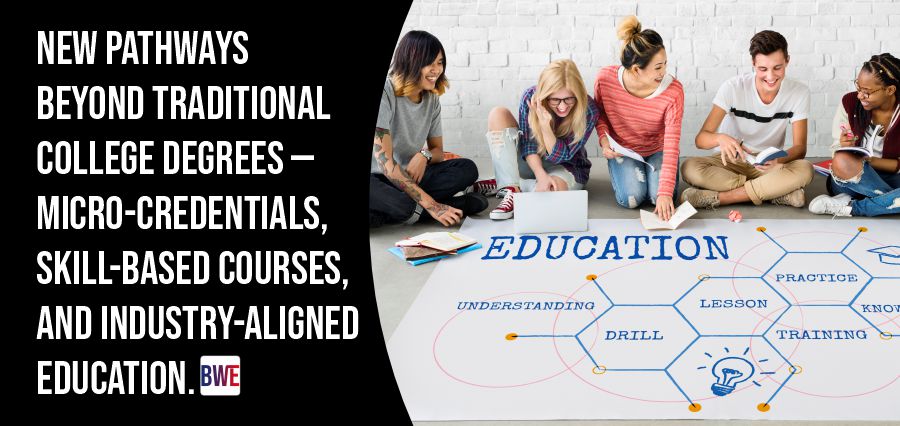
Recent data shows that nearly four in ten workers will need to reskill or update their skills by 2030, as industries change rapidly and jobs evolve. Many traditional college degrees take years to complete and sometimes cover skills that employers may no longer need. In that context, it becomes important to find alternative routes that help learners build relevant, up-to-date skills quickly. Micro-credentials and skill-based courses emerge as realistic, timely options. They offer focused learning, often in weeks or a few months, rather than years, a shift that matters for people who want to start working sooner, switch careers, or adapt to new industry demands.
What micro-credentials and skill-based courses are
Micro-credentials refer to short, targeted learning experiences that certify specific competencies or skills instead of broad academic knowledge. These credentials can be obtained online or through blended learning. Sometimes they are delivered by universities, sometimes by industry platforms or training providers. They often involve focused coursework relevant to occupations such as data analysis, digital marketing, cybersecurity, or UX design. Because micro-credentials zoom in on practical skills, they can become part of a stackable qualification path, learners can accumulate multiple micro-credentials and even combine them eventually with degree credit in some systems.
How these pathways compare with traditional degrees
Traditional degrees offer comprehensive academic exposure, general education, and opportunities for deeper study in a discipline. They remain valuable for roles that require broad thinking, advanced theory, or core disciplinary grounding. But they come with trade-offs: time, cost, and sometimes a mismatch between academic content and job requirements.
By contrast micro-credentials deliver fast, practical training with lower cost and time commitment. Learners can finish a course, build a portfolio, and apply for jobs in months rather than years. In many roles that demand specific technical or digital skills, this can provide a strong advantage. Employers globally report that hiring candidates with micro-credentials often reduces onboarding and training costs, and speed up their readiness to contribute.
Nevertheless micro-credentials do not always substitute for degrees when employers demand deep academic credentials or for roles that require a broad foundational background. The value of a micro-credential depends on context, the kind of job, industry, skill demand, and employer expectations.
Who benefits most from micro-credentials
Micro-credentials offer particular value to several kinds of learners. Working professionals who want to upskill or switch fields can use them to remain relevant without quitting their jobs. Individuals from non-traditional backgrounds or with economic constraints gain access to affordable, flexible education. Those who want to learn a specific trade or skills, such as programming, data analysis, digital marketing, or user-experience design, can quickly build job-ready competencies.
In countries where higher education capacity is limited or fees are high, micro-credentials can democratize access. They reduce barriers of time, money, or geography. For learners wishing to follow a non-linear career path, moving from healthcare to data science or from humanities to tech, these skill-based credentials present a realistic pathway.
What to check when picking a micro-credential or skill-based course
When choosing a micro-credential, verify whether the course content aligns with industry demand. Look for skill sets that employers actually value in job listings. Prefer credentials that are recognised by employers or industry bodies rather than obscure online badges with no value outside the learning platform.
Check whether the credential is stackable or convertible into formal qualifications. Some institutions allow micro-credential credits to be transferred toward degree programmes. Consider reputation of the issuing platform or institution. Well-established platforms or providers that update curricula regularly will likely offer more relevant, up-to-date skills.
Also examine the potential return on investment. While micro-credentials often cost far less than degrees and require less time, value depends on demand for those skills in the job market. Weigh cost savings against expected employment outcomes, salary gains, or career mobility.
Final takeaways
Micro-credentials and skill-based courses represent serious alternatives to traditional college degrees for many people. They offer focused, flexible, affordable learning that has clear value when matched to in-demand skills and roles. For learners who want to enter the workforce quickly, switch careers, or pursue lifelong learning, these pathways deliver tangible benefits.
That said the choice depends on personal goals and context. When career goals demand deep academic grounding or broad disciplined thinking, a degree may still be the right path. Where the goal is practical skills, flexibility, and agility, micro-credentials can deliver.
What this really means is that education today should feel less like a one-time rite of passage and more like a lifelong tool kit. Anyone can build skills as they go, shape their career path, and adapt to changing markets. The future of learning might lie less in single lifetimes of study and more in many small, strategic learning steps that add up.
Read Also: Dr. Tharshiny Pankaj: Widening Participation in Learning for All