
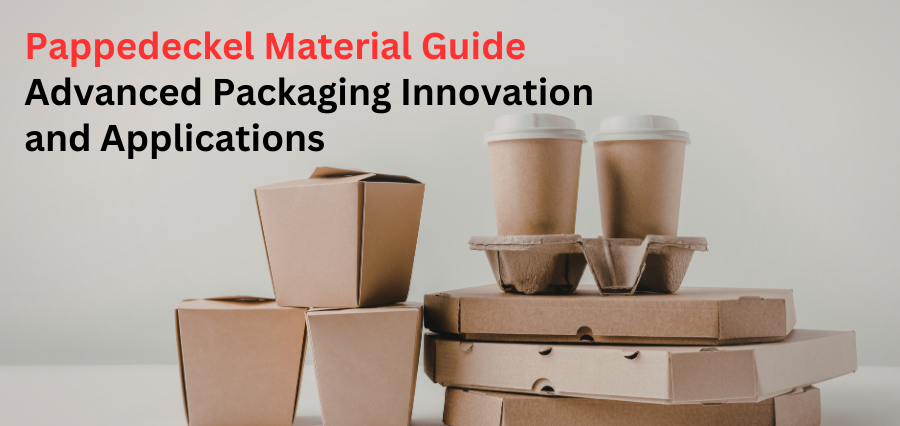
Packaging has always been about one core promise: protect the product, deliver it safely, and keep it presentable until the customer opens it. What has changed is the pressure on packaging to do far more than protection. Today, businesses expect packaging materials to be durable, printable, lightweight, cost-efficient, and sustainable.
That is where pappedeckel has earned a serious place in modern packaging conversations.
Often described as a rigid paper-based board, pappedeckel is widely used in everything from covers and backing boards to premium box structures. It is essentially a compressed, thick paperboard material designed to provide stability and strength while still remaining practical for high-volume packaging needs.
Pappedeckel is a robust cardboard or paperboard substance that acts as a lid, a cover or a shield in the realm of packaging and storage. The word comes from the German language and it has a close association with cardboard and covering products.
Pappedeckel, unlike thin paper or light carton stock, has the properties of a strong material, hence it can be used in the packaging designs that require firmness, shape, and the ability to be stacked.
Pappedeckel stands out because it offers:
Packaging buyers and product brands look at three big concerns:
Pappedeckel supports all three, which is why it is increasingly discussed in the context of eco-friendly packaging and modern paperboard packaging solutions.
The growth of pappedeckel is mainly attributed to its strong positioning as an alternative to plastic-based covers and lids. Paperboard-based solutions are often chosen due to their being recyclable and biodegradable if they do not have excessive plastic barriers designed around them.
Thus, pappedeckel remains a viable option for brands seeking to improve their environmental footprint without sacrificing packaging functionality.
Pappedeckel offers a plethora of thickness and density variations as its major advantage, giving packagers the flexibility to choose the perfect cardboard for the particular purpose.
Thickness is usually expressed in millimeters or GSM, and the manufacturers opt for lighter boards for soft covers and the heavy ones for sturdy packaging constructions.
This flexibility helps pappedeckel work across both industrial packaging and consumer packaging categories.
In order to grasp the pappedeckel innovation, it is good to take a look at other widely used packaging materials worldwide for the comparison.
Folding Cartons vs Corrugated vs Rigid Packaging
Usually, packaging is classified into three rough types:
Each alternative meets different requirements in terms of sturdiness, advertising, and shipping.
Pappedeckel is very much connected with the durability of rigid packaging, especially when it is used as a supporting layer.
Folding Box Board (FBB) vs Pappedeckel
Folding Box Board has been the favored material for the production of cartons, mainly for the food, cosmetics, and pharmaceutical sectors. The main benefit of its multilayered pulp construction is the ability to create a very light and strong material with an excellent printing surface.
Conversely, Pappedeckel is a material that emphasizes the stiffness and strength characteristics, and is thus mainly used in protective covers, stiff packaging parts, and packaging components that require shape stability.
Pappedeckel used to be seen as just a basic cover material but now it is regarded by brands and packaging engineers as a smart choice of packaging for:
The development is very much connected to the innovations in board engineering and the packaging design thinking.
Present-day packaging is not satisfied with just plain board. A lot of pappedeckel variations have now incorporated coatings that not only resist stains or moisture but also give a nice look to the packaging.
At this very moment, pappedeckel shifts from a mere cardboard lid to a valuable packaging part.
The Pappedeckel innovation is not only determined by its material but also by the way packaging brands apply it to modern-day requirements.
1. Stronger Packaging With Less Material Waste
Lightness in packaging for brands but assuring protection at the same time. Pappedeckel gives a perfect combination of lightness and sturdy, thus preventing over-packaging and protecting the products at the same time.
This is significant for:
2. Better Printing, Branding and Shelf Appeal
It is said that people buy with their eyes first. A very good product with poor packaging presentation may still lose some customers due to lack of trust. Pappedeckel with its modern finishing and coating techniques can make the weak marketing wall in the packaging area support the brand’s expectations:
3. Green Packaging Decision Made By Sustainability
Sustainability has moved from being a nice-to-have feature to being a must-have feature. Numerous brands are proactively looking for recyclable packaging materials, biodegradable packaging alternatives and paper-based packaging solutions.
Pappedeckel is one of the frequently mentioned packaging materials which is said to be recyclable and biodegradable, especially in comparison with plastics.
Pappedeckel is a multifunctional material. It is widely used for various types of packaging, from standard to premium extravagant packaging seal.
Choosing the right pappedeckel depends on the product type, shipping requirements, and branding goals.
Pappedeckel is set to take a good position in the future of packaging as it occupies a place where four things meet:
It is expected that as the innovative trend in packaging keeps shifting towards paper-based solutions, pappedeckel should be even more used in the areas of protective packaging, box-packaging, and eco-friendly retail-packing.
Pappedeckel has evolved from being seen as a basic cardboard cover into a practical material for modern packaging engineering. With options in thickness, finishing, and application flexibility, it supports both functional packaging demands and premium brand presentation.
For brands that want sustainable packaging materials without compromising on structure, pappedeckel offers a clear advantage. It is lightweight, rigid, adaptable, and aligned with the direction the packaging industry continues to move.
Read Also – Tom Welling Net Worth 2026 | Career & Earnings Breakdown

Welcome to Business World Eureka, your premier destination for global business intelligence. We are a leading digital magazine platform, committed to delivering the latest business insights, trends, technologies, news and press releases from across the globe.
©Copyright at Business World Eureka 2025 | All Rights Reserved