
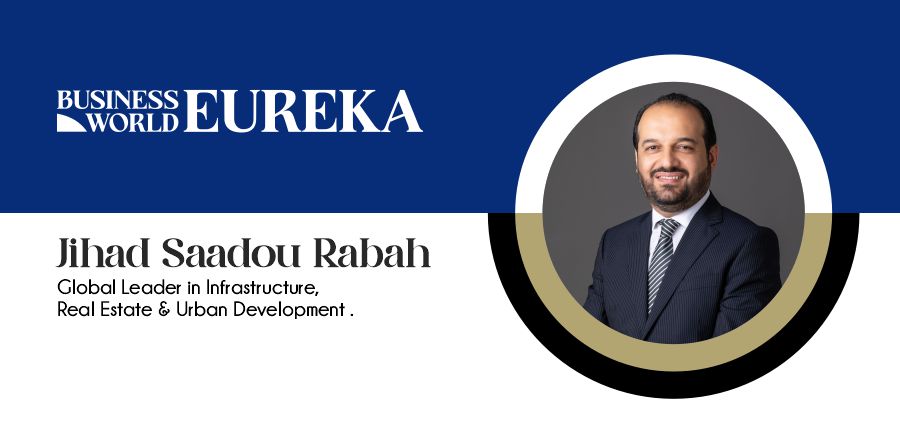
On a mission to lead airports, housing and logistics programs through disciplined governance!
Most people walk through a city and see roads, towers, terminals, and street lights. Few pause to imagine decisions beneath the soil, or the years of planning that allow families to trust that water will run, flights will land safely, and permits will move through a digital system. A moment of silence at dawn beside a construction fence can reveal a truth many overlook. Cities are agreements between leaders and communities about stability, mobility, and dignity.
This realization forms the quiet center of Jihad Saadou Rabah’s life work. His career revolves around large scale infrastructure. Yet the foundations of his vision reach deeper into questions of national identity, economic resilience, and collective ambition. When he stands at a site where cranes lift steel, he senses more than engineering. He senses the promise of social transformation at scale.
He said, I don’t just build cities — I shape nations, empower systems, and deliver transformation at scale. Those words came from lived experience across decades, carrying the weight of responsibility and foresight.
Let us learn more about his journey:
A record of steering large scale transformation
With more than 25 years of executive leadership across the Gulf, Jihad has influenced portfolios exceeding USD 40 billion in value. Airports, logistics hubs, smart cities, mixed use masterplans, and national housing initiatives all sit within his track record.
These undertakings involve multiple ministries, regulators, contractors, international financiers, and technology providers. Aligning such stakeholders requires strong governance discipline. In regions pursuing diversification agendas and accelerated urban expansion, execution certainty becomes a strategic imperative.
Jihad built a reputation for translating high level national visions into operational delivery milestones. His insistence on clarity and alignment strengthens project velocity and protects public value.
Turning complexity into clarity
Large capital portfolios frequently face bottlenecks driven by fractured reporting, insufficient escalation mechanisms, and unclear accountability. Jihad is known for bringing coherence to such environments.
Colleagues point to his approach: disciplined governance frameworks, transparent reporting structures, agile delivery principles, and realigned stakeholder incentives. These tools convert risk from abstract threat into manageable pathways.
His leadership extends across revitalization of underperforming portfolios and multi billion dollar transformations across borders. He often assumes responsibility in contexts where contractual, political, and fiscal layers overlap at high stakes. Through analytical guidance and institutional alignment, he protects intended outcomes and strengthens credibility among investors and regulatory bodies.
He stated, “Whether revitalizing underperforming portfolios or driving multi-billion-dollar transformations, I bring a proven track record in strategic foresight, disciplined governance, stakeholder alignment, and agile delivery.”
Digital transformation and new performance expectations
Governments across the Gulf have moved toward digital integration to accelerate permitting and inspection procedures. Jihad has been instrumental in designing and implementing frameworks that reduce cycle times and improve transparency.
In some cases, permitting durations dropped by more than 50%. Such improvements influence investor sentiment, contractor cash flow, workforce stability, and national competitiveness.
His project teams deploy performance dashboards and data driven escalation models that embed accountability across program layers. Decision makers gain visibility, and operational uncertainty declines. Through these reforms, infrastructure development becomes aligned with broader digital economies and governance modernization.
Strengthening Urban Planning Systems: A Mandate at the Governmental Entity
During his tenure supporting the Governmental Entity in Saudi Arabia, Jihad assumed responsibility for business transformation within the Urban Planning Deputyship. The role demanded discipline, diplomacy across government channels, and credibility grounded in delivery. He led change management initiatives intended to elevate efficiency, strengthen service delivery, and align planning outcomes with national urban growth priorities.
His mandate included developing strategies that optimized processes, systems, and organizational structures inside the Deputyship. He approached these mandates with analytical rigor, building pathways that aligned daily operations to strategic objectives. Digital integration sat at the center of this transformation, where he identified opportunities to automate planning functions, streamline approvals, and modernize core workflows.
The work extended to management of projects tied to business process reengineering and organizational redesign. Through structured governance, he safeguarded project intent and ensured measurable results. Jihad provided senior leaders with advice grounded in best practices in urban planning, regulatory reform, and public service delivery. His recommendations reinforced confidence that reforms would improve both transparency and service outcomes.
Data driven oversight remained critical. Jihad developed performance metrics and dashboards to monitor key indicators related to progress inside the Deputyship. These tools surfaced bottlenecks early, revealed areas in need of improvement, and enabled leadership to track alignment with strategic objectives.
Transformation inside government systems depends on cooperation across institutions. Jihad invested in relationships with stakeholders across the governmental entity and other government entities to improve integration and coordination on urban planning initiatives. Better alignment between departments created conditions for more reliable execution and reduced friction across planning cycles.
He reported regularly to leadership inside the governmental entity and Urban Planning Deputyship, clarifying progress to date, emerging challenges, and next steps to achieve strategic ambitions. Such transparency builds trust between operational teams and senior figures accountable for national planning outcomes.
This chapter of his career reflects how his governance philosophy functions in practice: optimize systems without compromising integrity, modernize processes to support long range planning, and elevate institutional competence to match the scale of national urban aspirations.
Governance culture across borders
Infrastructure portfolios of national significance require systems resilient to leadership turnover, market shocks, and policy shifts. Jihad contributes to building governance and program management practices capable of sustaining continuity.
He led turnarounds of multi million dollar programs when performance declined and advised sovereign funds and major private developers on adaptive city models and future ready infrastructure systems.
His methodology blends foresight and precision execution. Institutional capacity, stakeholder incentives, and risk appetite are each examined before reforms occur. Strategy is linked to execution through milestones and forecast models that safeguard long term economic and social intent.
Commitment to education and institutional capability
Jihad understands that infrastructure maturity requires investment in human capital. His advisory work within higher education strengthens alignment between academia, policy, and industry demands.
He mentors future engineers, planners, and public leaders, encouraging them to understand infrastructure through economic, cultural, and environmental lenses. With a Master’s degree in Programme Management and a PMP certification, Jihad brings technical grounding and strategic insight.
He stresses mindset and ethics alongside technical proficiency, asserting that large scale leadership requires humility and accountability when public resources are involved.
Cross cultural fluency and high trust leadership
Infrastructure delivery spans borders and institutions. Jihad’s fluency in English, Arabic, and French allows him to engage multicultural stakeholders with nuance. His communication style promotes trust and unity during periods of intense pressure and uncertainty.
Teams describe an environment where intellectual discipline and empathetic leadership coexist. That balance builds resilience during complex negotiations, schedule compression, and regulatory shifts.
Why infrastructure matters
Airports enable global connectivity. Logistics corridors strengthen trade flows. Smart districts support knowledge economies. National housing developments influence social cohesion and demographic stability.
For Jihad, execution must support public value long after completion. Governance frameworks and performance models become foundational to institutional maturity. His projects reflect long term results: stronger economies, trusted public systems, and communities with expanded opportunity.
Infrastructure as ecosystem
Jihad emphasizes that infrastructure cannot be treated solely as engineering. It is interdependent with culture, governance, planning intelligence, regulatory maturity, and data transparency.
He advocates early planning models that anticipate disruption arising from climate exposure, financial volatility, demographic pressure, or technology transition. Resilience, in his view, is an economic and civic strategic necessity.
Stewardship, accountability, and national confidence
Jihad brings steadiness under high pressure. His leadership philosophy centers on transparency, structured escalation pathways, and protection of public trust.
Escalation mechanisms occur early. Risk communication is encouraged rather than suppressed. Governance culture matures through accountability. Such discipline strengthens credibility, particularly when infrastructure budgets reach billions and international partners expect certainty.
Urbanization across the Gulf accelerates. National visions reaffirm investment in transport connectivity, logistics capacity, smart districts, education hubs, and housing ecosystems.
Jihad continues to guide this evolution through disciplined governance, performance systems, and stakeholder alignment. He positions institutional capability development as key to long horizon competitiveness.
Also Read : 10 Ways Leaders Can Build Psychological Safety That Transforms Teams