Children who enter school with strong social and emotional skills enjoy advantages that go beyond grades. Research shows that early social-emotional learning (SEL) significantly reduces both externalizing behaviors (like aggression) and internalizing behaviors (like anxiety). At higher education levels, students with solid emotional regulation, resilience, and interpersonal abilities tend to perform better academically and adapt more smoothly to complex environments.
This growing body of evidence highlights a shift in education’s purpose: from delivering content to nurturing human capacities. What this really means is that soft skills, well-being and SEL deserve a central place in how we design learning from early years through college.
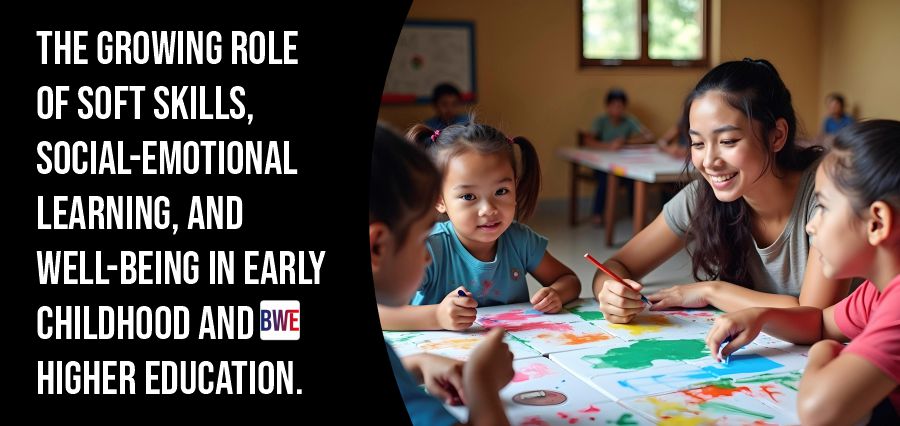
Social-emotional learning refers to teaching children how to understand and manage emotions, build empathy, form healthy relationships and make thoughtful decisions. In early childhood settings, SEL helps children learn sharing, cooperation, self-control and emotional regulation, abilities that set the foundation for social competence and school readiness.
When children receive SEL early, they are more likely to develop healthy relationships, handle stress better and avoid behavioral problems. Research involving thousands of children shows that SEL programs can lead to medium to large improvements in social skills, emotional well-being and classroom behavior.
These gains often translate into better academic readiness. When a preschooler knows how to manage frustration or communicate needs appropriately, that child can focus more on learning rather than getting overwhelmed or acting out. SEL shapes not only the way children behave, but how ready they are to absorb knowledge and grow intellectually.
At the college level, social-emotional competencies continue to carry weight. Students who navigate relationships well, control stress, and adapt socially tend to persist in their courses and perform better academically.
SEL is not a remedial add-on. It helps build a positive learning environment where students feel they belong, stay engaged, and commit to their studies. When these conditions exist, learning becomes more effective and meaningful.
Beyond academic life, these skills help individuals interact in workplaces, communities, and personal relationships. Emotional intelligence, self-awareness, empathy and responsible decision-making form the core of social success in adulthood.
Treating well-being and soft skills as essential, not optional extras, can reshape how higher education treats student readiness and long-term growth. It shifts focus from purely technical knowledge to well-rounded human development.
Consider a preschool that integrates SEL activities: children are encouraged to speak about their feelings, play cooperative games, and practice empathy and sharing. Over time, teachers notice fewer conflicts, calmer transitions between activities, and children who respond better to frustrations. The classroom becomes a place of learning and emotional safety rather than stress. That scenario reflects findings from studies deploying SEL in early childhood settings.
Now imagine a university course where instructors encourage group discussions, reflective exercises and collaborative problem-solving rather than only lectures and exams. Students in such settings often report higher motivation, sense of belonging, and improved academic engagement. Research shows that social-emotional adjustment in higher education can boost retention and performance.
Another example arises in communities recovering from stress or trauma, such as widespread disruptions in childhood education due to recent events globally. In those contexts SEL can play a healing role: by helping children regain confidence, rebuild social bonds and restore emotional well-being.
The growing evidence behind SEL and well-being suggests that educators and policymakers need to rethink priorities. Academic content remains important. However placing equal emphasis on soft skills and mental health can yield stronger, more resilient learners.
For parents, early investment in children’s emotional development matters. Teaching empathy, emotional regulation and communication from young ages builds a foundation for lifelong success, in school and beyond.
Institutions of higher learning can benefit by embedding social-emotional development into courses, campus life and student support, not as an afterthought but as a core element of education. That may lead to better completion rates, healthier students and graduates equipped for modern challenges. What this really means is a shift from seeing education as delivery of information to viewing it as cultivation of whole people.
Soft skills, social-emotional learning and well-being are not soft extras. They form a backbone of successful learning journeys, from the earliest classroom to the university lecture hall. Evidence shows SEL improves behavior, mental health, academic outcomes and prepares individuals to navigate life with resilience, empathy and collaboration. Schools and colleges that embrace this understanding act in service of more than exam results. They build generations of thoughtful, adaptive, socially connected human beings. For parents, educators and policymakers the message is clear. Fostering soft skills and emotional health matters.
Read More – New pathways beyond traditional college degrees